
When Caroline Ronsseray first noticed something unusual about her three-year-old son, Gaspard, it did not arrive as a dramatic moment of panic or fear. It arrived quietly—almost invisibly—wrapped in the ordinariness of daily life.
Gaspard was struggling with something simple: using the toilet.
At first glance, it seemed harmless. Toddlers regress. Accidents happen. Children go through phases, especially during times of growth and emotional development. Friends reassured her. Doctors echoed the same sentiment. There was no obvious emergency, no immediate red flag demanding alarm.
So Caroline tried to believe them.
Yet something inside her resisted that comfort.
There was a hesitation in Gaspard’s movements that felt unfamiliar. A stiffness that lingered too long. A discomfort that didn’t fade with time. And in his eyes, Caroline saw something that made her pause—not fear, not pain exactly, but confusion. As if his body was trying to tell him something he was too young to understand.
That quiet unease—the kind that doesn’t scream but refuses to be silenced—stayed with her.
When a Mother’s Instinct Refuses to Let Go
At first, Caroline tried to push the worry aside. Life was busy. Gaspard was young. Everyone said it was normal.
But as days turned into weeks, the signs became harder to ignore.
Gaspard began complaining of pain in his legs. He tired more easily than before, needing to rest after short bursts of activity. His appetite diminished, meals left unfinished. And then there was his stomach—slightly swollen, firm in a way that didn’t match the soft, round belly of a healthy child.
What had once been a quiet concern grew into something heavier.
Caroline’s instinct sharpened into urgency.
She returned to the hospital and insisted on further testing. She asked questions that had no easy answers. She pressed gently but firmly, unwilling to accept reassurance that no longer matched what she saw in her child.
And then, in a matter of moments, everything changed.
The Truth That Shattered Normalcy
Imaging scans revealed what words could barely contain.
A tumor—measuring twelve centimeters—was pressing against Gaspard’s prostate and bladder.
Twelve centimeters.
In a three-year-old body.
The diagnosis followed swiftly and mercilessly: stage three rhabdomyosarcoma, a rare and aggressive soft-tissue cancer that primarily affects children.
In that instant, the world tilted.
Gaspard was barely old enough to understand illness, pain, or mortality. He didn’t know what cancer meant. He didn’t know that his body was fighting something dangerous and relentless.
But Caroline knew.
She felt the weight of every possibility collapse onto her at once. Fear, disbelief, grief for a childhood suddenly interrupted—all of it rushed in without warning.
And yet, when she looked at her son, she saw something that stopped her breath.
Not fear.
Trust.
A Battle No Child Should Ever Have to Fight
The path forward was explained in clinical terms: chemotherapy, proton therapy, scans, procedures, hospital stays.
Medical language softened nothing.
Their child would suffer.
And still, Gaspard faced the beginning of that journey with a quiet bravery that astonished everyone around him.
Over the next six months, he endured nine cycles of chemotherapy. His small body grew thinner. His hair fell out in gentle clumps. Nausea became a constant companion. Hospital rooms replaced playgrounds. IV poles became familiar silhouettes.
Yet Gaspard rarely complained.
“He never asked why,” Caroline remembers. “Even when it hurt, he just… kept going.”
There were moments of exhaustion. Moments of fear. Moments when Caroline wished she could carry the burden for him.
But Gaspard met each day with resilience far beyond his years—smiling at nurses, clutching toys during treatments, finding joy wherever he could.
Then came the next phase.
Proton Therapy and the Weight of Endurance
The family traveled to Florida for proton beam therapy, a highly targeted form of radiation designed to shrink the tumor while protecting surrounding organs.
For three months, Gaspard endured daily sessions that tested the limits of his strength.
Each treatment demanded stillness from a body built for movement. Each day required courage no toddler should ever need to summon.
And still—he persevered.
Through it all, Caroline remained at his side, her belief in him unwavering. She learned the rhythms of hospital life, the language of scans and blood counts, the balance between hope and realism.
She also learned something deeper: that advocacy is an act of love.
Small Victories, Earned Inch by Inch
By July 2019, cautious relief arrived.
The tumor had shrunk significantly.
It was not a declaration of victory—but it was hope.
Strength returned in fragments. Gaspard kicked a ball. He laughed under open skies. He reclaimed small pieces of childhood that illness had tried to steal.
But the fight was not finished.
A year-long maintenance chemotherapy regimen followed, marked by vigilance, patience, and constant monitoring. Every fever mattered. Every scan carried emotional weight. Every appointment brought a mixture of fear and anticipation.
Caroline never stopped listening to her instincts.
When concerns were dismissed, she pushed.
When answers were unclear, she asked again.
When something felt off, she trusted herself.
“That persistence saved my son’s life,” she says without hesitation.
Life After Survival
By the end of that long, grueling year, the words every parent longs to hear finally arrived.
The cancer had responded.
Gaspard had survived.
Today, Gaspard is ten years old—and cancer-free.
He runs. He plays. He learns. He laughs. He lives fully in a childhood that once stood on the edge of loss.
He remembers little of the pain, but the resilience remains woven into who he is.
Ordinary moments now carry extraordinary meaning.
A school project.
A birthday party.
A soccer match under the sun.
Each one is a quiet celebration of life reclaimed.
Turning Pain Into Purpose
Caroline’s journey did not end with remission.
The family became advocates for pediatric cancer research, supporting Great Ormond Street Hospital and participating in RBC Race for the Kids 2025—helping fund the very innovations that saved their son’s life.
“The Children’s Cancer Centre changed everything for us,” Caroline explains. “It wasn’t just treatment. It was guidance, compassion, and hope.”
Gaspard’s story now reaches far beyond their home, shared among parents, caregivers, and medical professionals as a powerful reminder of one essential truth:
Listen to parents.
Too often, early warning signs are dismissed as minor, developmental, or temporary. In Gaspard’s case, ignoring a mother’s intuition could have cost a life.
A Message That Matters
Stage three rhabdomyosarcoma is rare.
Aggressive.
Unforgiving.
But Gaspard’s survival proves what early detection, expert care, and relentless advocacy can achieve.
Caroline now speaks to other parents, urging them not to doubt themselves.
“You know your child,” she says. “If something feels wrong, don’t stop asking questions. Your voice can save a life.”
Today, Gaspard’s laughter fills spaces once occupied by fear. His joy stands as living proof of every sleepless night, every tear, every moment his family refused to surrender.
From a subtle struggle in the bathroom to a life-threatening diagnosis…
From fear to hope…
From survival to thriving…
Gaspard’s journey is a testament to the fragility of life—and the strength hidden within it.
It is the story of a mother who trusted her instincts.
A child who faced the unimaginable with quiet courage.
And a family who turned vigilance into victory.
Because sometimes, noticing the smallest sign makes all the difference in the world.
Bowen: A Little Warrior, A Big Heart
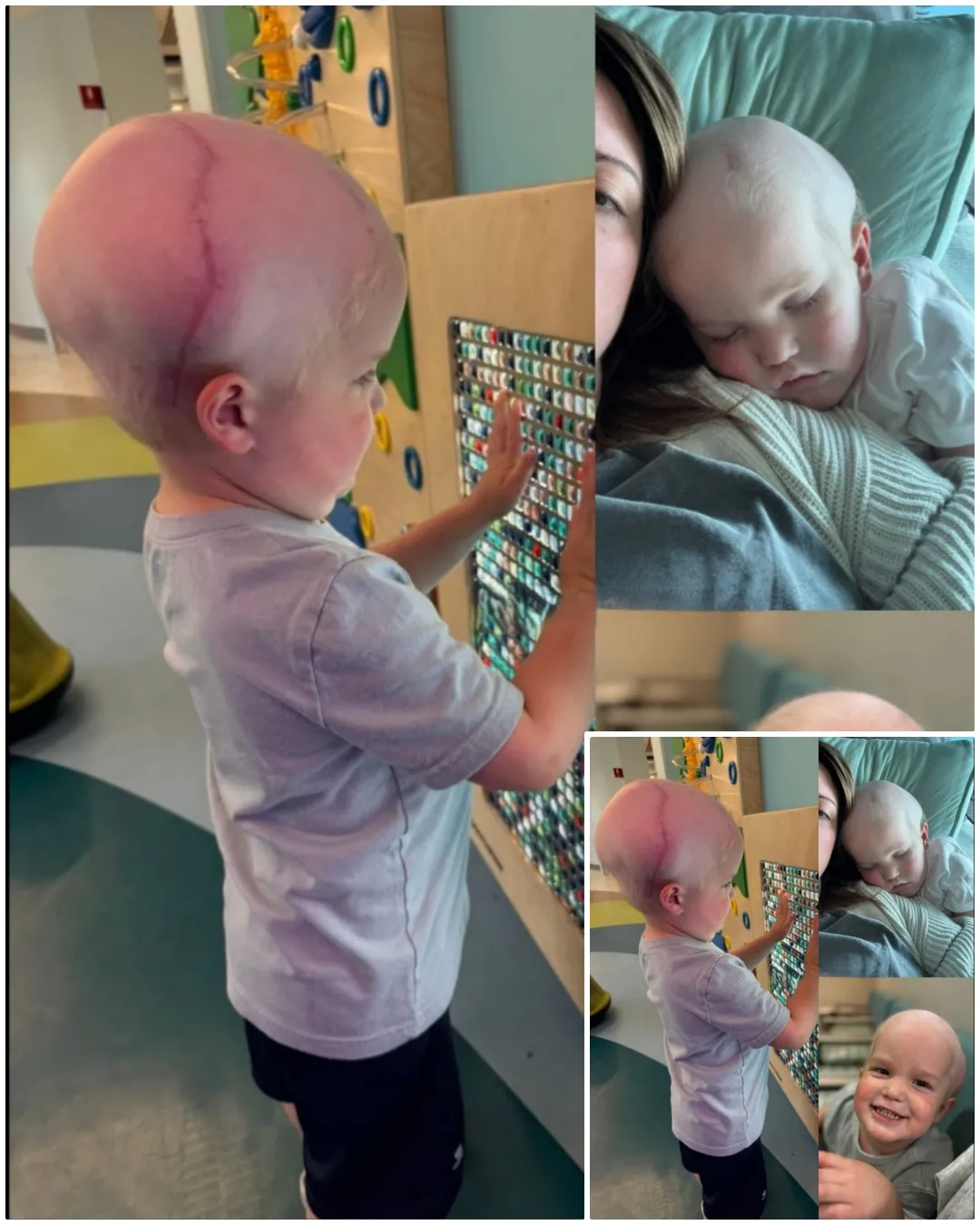
At just three years old, Bowen has already faced challenges that no child should ever endure. His tiny body has been through brain surgery, relentless chemotherapy, painful infections, and months confined to sterile hospital rooms. The beeping of monitors, the hum of ventilators, and the sterile smell of antiseptic have been the soundtrack of a childhood that should have been filled with playgrounds, birthday parties, and sunny afternoons. Yet, through every injection, every sleepless night, and every moment of pain, Bowen’s spirit has remained unbroken.