
After more than a year spent in a hospital room, surrounded by the sterile hum of machines and the unyielding buzz of monitors, Millie finally received the heart that had the potential to save her life. It was a heart full of hope—a heart that would give her a chance at life again. But as with any miracle, the journey has never been simple, and now, Millie faces a battle she could never have imagined, testing the limits of her tiny body and her parents’ resolve.
Millie’s story began long before the transplant. Before the heart that would give her life arrived, her own heart had been failing her. For years, Millie could barely keep up with the demands of a typical childhood. She couldn’t eat without vomiting. She couldn’t gain weight. Every day was a struggle just to survive. Her parents had been told time and again that there were no options left, that her heart was too weak to support her anymore. And yet, in the impossible space between faith and reality, they continued to hold onto one last, fragile hope: a transplant.
When the phone call came, it was a moment of relief—a moment that had been prayed for, dreamed about, and fought for. A heart had been found. Millie would have the chance at life that she so desperately needed. But what was supposed to be a fresh start—a new beginning—has become yet another test of strength and faith.
The transplant itself went as well as could be expected, and for a brief time, Millie’s family thought they had beaten the odds. They thought that perhaps, just perhaps, they would finally have the happy ending they had prayed for. But the road to recovery is never simple, and the joy that came with the new heart has been tempered by the harsh reality of rejection.
After undergoing a biopsy and heart catheterization, Millie’s doctors delivered devastating news: her body was rejecting the new heart. This wasn’t just one kind of rejection—it was two.
First came the acute cellular rejection. Her body’s own T-cells, the very soldiers meant to protect her, were attacking the heart muscle. Then came the antibody-mediated rejection, where her body’s antibodies were damaging the blood vessels that were meant to nourish and sustain the heart. It was a cruel twist of fate, one that nobody had expected after such a long and arduous journey.
Millie’s parents received the news with heavy hearts. It was a blow that felt impossible to absorb, especially after all that they had been through. They had walked the painful road of watching their daughter suffer, witnessing her body slowly fail in ways that no parent should have to witness. They had spent sleepless nights, praying for a miracle, hoping for a chance at life. Now, that miracle was being tested in ways they never anticipated.
Millie was admitted immediately for further treatment, which meant more medications, more uncertainty, and more waiting. Every day felt like an eternity. The doctors were hopeful that they had caught the rejection early enough to intervene, but the journey ahead would be anything but easy. With more treatments, more trial and error, and a world of unknowns ahead, the family is holding onto their faith with everything they have.
The most heart-wrenching part of this journey is the weight of it all. Millie’s family had already walked through the fire of uncertainty, loss, and fear. They had watched their daughter’s tiny body fight just to survive. Now, they face another battle—a fight to keep the heart that was meant to save her. But through it all, they hold on to one unwavering truth: they will never give up on Millie. They will fight for her with every ounce of strength they have.
It’s a reality no parent should ever have to face: knowing that your child is fighting for her life, knowing that the hope you fought so hard to hold onto is being tested in the most unimaginable way. Yet, despite the heartache and fear, Millie’s parents continue to ask for one thing: prayers.
The doctors have done everything they can to catch the rejection early. They’ve already begun a regimen of new medications, trying to reverse the damage done by the attack on her heart. Millie’s body is small, fragile, and vulnerable, but her spirit is anything but. She has already shown incredible strength, proving time and again that she is a fighter, that she is a warrior.
Now, it is time for the rest of us to stand with Millie’s family. It is time to send our most powerful prayers—prayers of healing, of strength, and of hope. Prayers that the medications will work, that Millie’s body will accept the heart that has been gifted to her, and that she will one day be able to go home, where she belongs.
Millie’s journey is far from over, but one thing is certain: she is not alone. Her parents, her doctors, her family, and all of us who have followed her story, are standing beside her, sending our love, our prayers, and our support. We are fighting for her, as she has fought for so long.
Her family asks that you share your most powerful words with her today. Whether it is a prayer, a message of hope, or simply a word of encouragement, let Millie know that she is loved, that we are all praying for her, and that we believe in her strength.
We have already witnessed miracles in her journey—now, we are asking for one more.
Millie’s story is a testament to the power of love, the strength of the human spirit, and the unshakable faith that can carry us through even the darkest of times. She has already come so far. With your prayers, with your love, Millie’s family knows that she will continue to fight.
Please share your prayers and encouragement for Millie today. She needs them now more than ever.
Prayers up for Millie—our little warrior.
Separated by Glass, United by Love: Two Sisters’ Journey Toward a Christmas Miracle.332
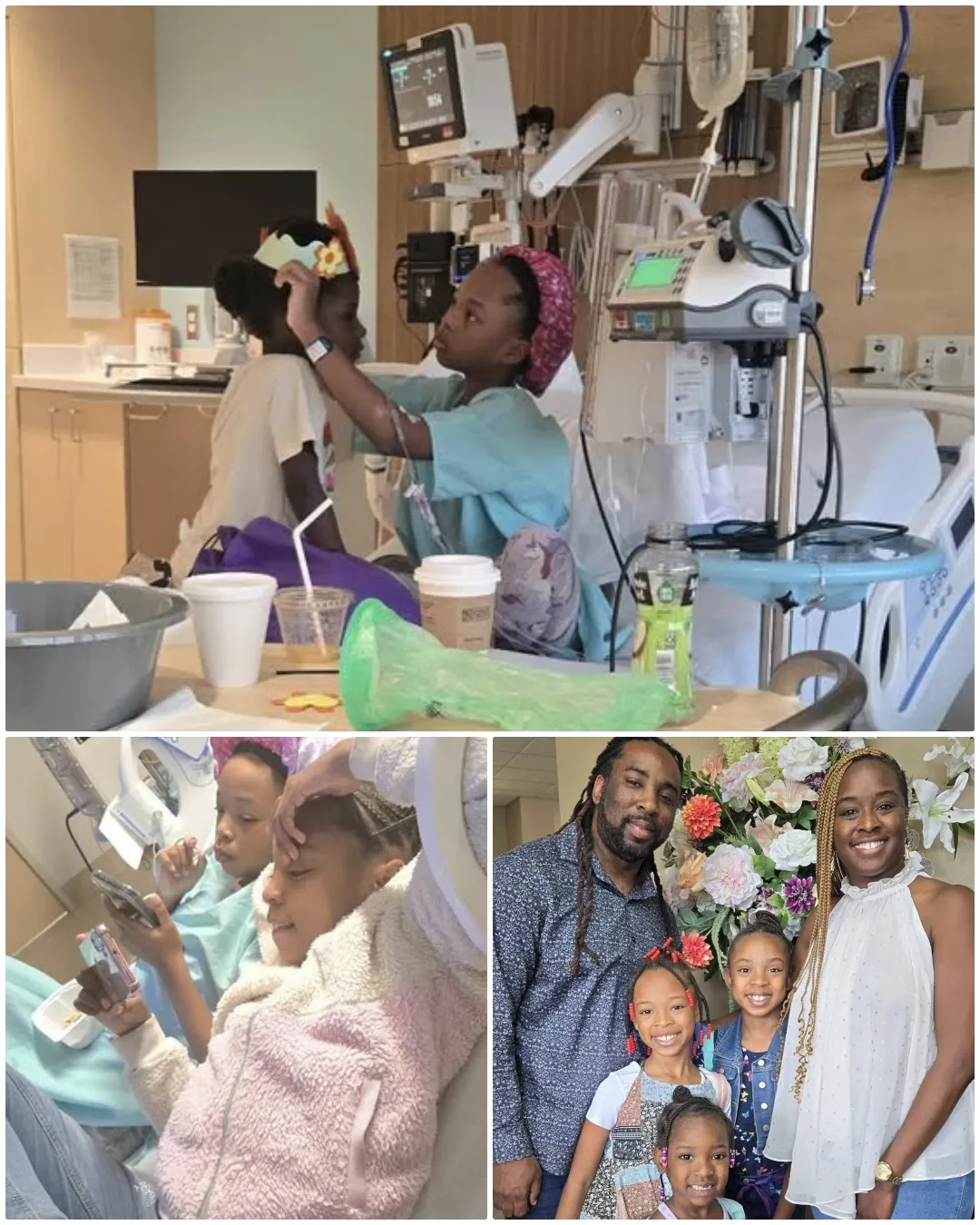
Their names are Kennedy and Kendall, and they have always been inseparable.
They are the kind of sisters who don’t just grow up together, but move through life together
. Best friends by nature. Teammates by instinct. The kind who know what the other is thinking without a word being spoken. The kind who reach for each other automatically—until they were told they could no longer touch.
For months now, their relationship has been defined by rules no children should have to follow.
No hugs.
No shared rooms.
No sitting side by side.
Just waves through glass.
Just voices carried across a few careful feet of space.
Just love held back by necessity.
Life on Opposite Sides of the Glass
Right now, Kendall is living in strict medical quarantine.
She is preparing for a bone marrow transplant, a procedure doctors hope will finally free her from the disease that has caused her pain every single day of her life: sickle cell disease.
The quarantine is essential. Any infection could be dangerous—possibly life-threatening. And so, for Kendall’s safety, the world has shrunk. Family visits are limited. Physical contact is forbidden. Even her sister, her closest comfort, must remain on the other side of the glass.
“I can’t hug her,” Kendall said quietly. “And that hurts.”
It hurts in a way that has nothing to do with needles or medicine.

It hurts in a way only children understand instinctively—when the person who makes you feel safe is close enough to see, but not close enough to touch.
A Childhood Defined by Pain
Sickle cell disease has been Kendall’s constant companion since birth.
It is a disease that most people don’t truly understand unless they’ve witnessed it up close. It causes severe pain, unpredictable complications, frequent hospitalizations, and overwhelming fatigue. For Kendall, it has meant days she couldn’t play. Nights she couldn’t sleep. Moments when her body betrayed her without warning.
Pain has not been an occasional visitor in Kendall’s life.
It has been a daily reality.
Her mother, Marquitta, has watched it all unfold—helpless at times, determined at others, but never giving up.
She has watched her daughter endure pain that would overwhelm many adults. She has watched her miss out on simple childhood joys. She has watched Kendall learn, far too early, how to be brave.
And from the moment Kendall was old enough to understand that her life would always be different, Marquitta made a quiet promise to herself:
She would do everything in her power to find her daughter relief.
The Search for Hope
That promise led them through years of doctor visits, treatments, setbacks, and uncertainty.
And eventually, it led them here—to the possibility of a bone marrow transplant. Not just treatment. Not just management.
A potential cure.
It is not a decision made lightly. Bone marrow transplants are intense, risky, and life-altering. They require months of preparation, chemotherapy, isolation, and recovery. But they also offer something sickle cell patients rarely dare to hope for: a future not defined by pain.
As part of the process, doctors tested Kendall’s siblings to see if any of them could be a donor.
Both of her sisters were tested.
And when the results came back, they revealed something extraordinary.
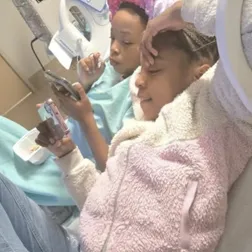
Kennedy was a perfect match.
“Please Let It Be Me”
When Marquitta remembers that moment, her voice still catches.
Kennedy didn’t hesitate. She didn’t ask what it meant for her. She didn’t ask how hard it would be.
“She said, ‘Please let it be me,’” Marquitta recalled.
Those words say everything about the bond between these sisters.
Kennedy didn’t see herself as making a sacrifice. She saw herself as helping her best friend. Helping her sister. Helping the person she loves most in the world.
And so began months of testing, appointments, treatments, and preparation—for both girls.
Kennedy prepared to give a part of herself so that her sister might finally live without pain.
Kendall prepared to endure chemotherapy and isolation so that her body might one day be free.
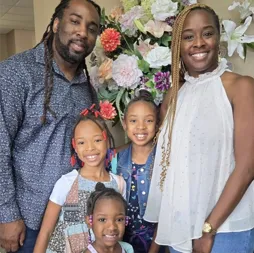
Waiting, Apart
As the transplant date drew closer, the rules became stricter.
Kendall entered full quarantine.
For safety, she and Kennedy could no longer be in the same room.
They adapted as best they could.
They waved through glass.
They talked on phones despite being only feet apart.
They smiled when they could, even when it was hard.
But nothing replaces a hug.
Nothing replaces sitting close, leaning into one another, or falling asleep side by side.
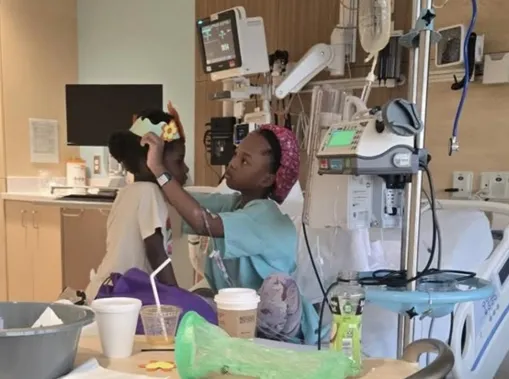
And yet, even separated, they remained connected—through looks, laughter, and a shared understanding that this separation had a purpose.
December 23: A Date That Holds Everything
After months of waiting, the transplant was finally scheduled for December 23, just days before Christmas.
The timing feels symbolic in ways words can barely capture.
A chance at a cure.
A chance at a life Kendall has never truly known.
A life where pain is not a daily expectation.
Where swimming is possible.
Where playing outside doesn’t come with fear.
Where spontaneous joy isn’t interrupted by illness.
A life where Kendall can simply be a child.
And a life where Kennedy doesn’t have to watch her sister suffer from the sidelines.
One Small Miracle Before Surgery
Then, on the night before surgery, something unexpected happened.
After months of separation, the doctors allowed the sisters to be together—just once.
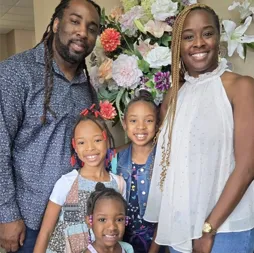
No glass.
No phone calls.
No distance.
Just sisters.
For the first time in months, they could sit beside each other. Touch. Hold hands. Be close in the way that had once been so natural.
“It seems like a miracle,” Marquitta said. “The thing we’ve been praying for.”
In that moment, the hospital room became something else entirely—not a place of illness, but a place of love, courage, and hope.
It wasn’t loud. It wasn’t dramatic.
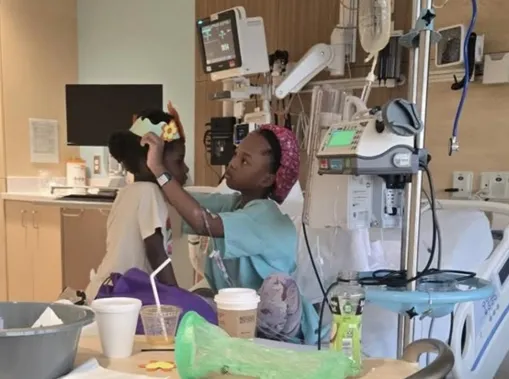
It was quiet. Sacred. Enough.
A Christmas Defined by Hope
This Christmas, sickle cell disease is still keeping these sisters apart.
But it is also bringing them closer than they have ever been to a cure.
Closer to a future where separation is no longer necessary.
Closer to a future where pain is no longer expected.
Closer to a future where two sisters can grow up side by side—without glass between them.
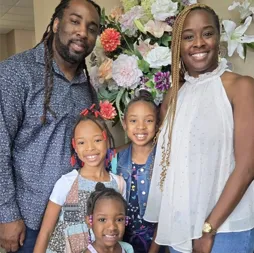
This family is holding onto hope with everything they have.
Hope that the transplant will work.
Hope that Kendall’s body will accept the gift her sister is giving.
Hope that this chapter of pain will finally come to an end.
Because sometimes, the most powerful miracles aren’t loud or instant.
Sometimes, they look like a sister saying, “Please let it be me.”
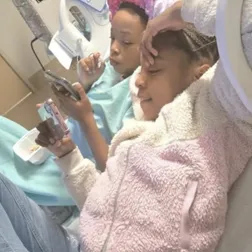
Sometimes, they look like two girls finally sitting together after months apart.
Sometimes, they look like a family daring to believe that life can be different.
And this Christmas, hope is the greatest gift they have.